Testing with OpenUniverse Simulated Data
Overview
The OpenUniverse simulated data approximate the High Latitude Time Domain Survey (HLTDS), and so cover sparse extragalactic fields. This is the only HLTDS simulation set RAPID has processed; the RimTimSim and SOC simulation sets are both GBTDS.
The tests described below are organized by processing date.
OpenUniverse simulated data are used, which cover the following observation range:
rapidopsdb=> select min(dateobs),max(dateobs) from l2files;
           min           |          max
-------------------------+------------------------
 2028-08-17 00:30:48.096 | 2032-11-27 01:23:22.56
(1 row)
The last exposure containing injected transients has DATE-OBS = 2030-08-15 01:23:31.2.
There is a gap in the dataset for MJD-OBS from 62,728 to 63,550 days, and subsequently a later
“post-survey” exposure set consisting of 1,155 exposures devoid of transients (starting with
DATE-OBS = 2032-11-14 00:30:48.096). Here is a breakdown by filter of the transient-free, post-survey exposures:
select fid,count(*)
from exposures
where dateobs>='2032-11-14'
group by fid
order by fid;

 fid | count
-----+-------
   1 |   165
   2 |   165
   3 |   165
   4 |   165
   5 |   165
   6 |   165
   7 |   165
(7 rows)
All 18 SCAs are included per exposure in the OpenUniverse simulated-image dataset. There are 7 filters covered by the OpenUniverse dataset (fid=8 or W146 is not included).
Look-up table all of the filter IDs versus Roman Space Telescope filter names included in the database:
rapidopsdb=> select * from filters order by fid;
 fid | filter
-----+--------
   1 | F184
   2 | H158
   3 | J129
   4 | K213
   5 | R062
   6 | Y106
   7 | Z087
   8 | W146
(8 rows)
Here is a 2-D histogram of numbers ofOpenUniverse exposure-SCA images versus sky position for the F184 filter:

All filters are covered uniformly in the OpenUniverse dataset, so the above figure is indicative of any of the available filters.
Summary of successful tests conducted thus far:
Test |
No. of images |
No. of ref. images made |
Start obs. datetime |
End obs. datetime |
Description |
|---|---|---|---|---|---|
4/28/2025 “standard test” |
2,069 |
1,696 |
2028-09-07 00:00:00 |
2028-09-08 08:30:00 |
All images in obs. range |
4/30/2025 |
5,222 |
None |
2029-03-15 00:00:00 |
2029-07-15 00:00:00 |
Only fields with superior ref. images |
5/5/2025 |
10,859 |
None |
2029-07-15 00:00:00 |
2030-03-15 00:00:00 |
Only fields with superior ref. images |
5/6/2025 |
4,858 |
3,995 |
2028-09-08 08:30:00 |
2028-09-12 00:00:00 |
All images in obs. range |
5/8/2025 |
3,020 |
1,500 |
2028-09-12 00:00:00 |
2028-09-15 00:00:00 |
All images in obs. range |
5/10/2025 |
13,850 |
4,876 |
2028-09-15 00:00:00 |
2028-09-25 00:00:00 |
All images in obs. range |
5/14/2025 |
2,069 |
None |
2028-09-07 00:00:00 |
2028-09-08 08:30:00 |
Repeat standard test with SFFT |
6/12/2025 |
3,545 |
79 |
2028-09-07 00:00:00 |
2029-09-20 00:00:00 |
Only ZOGY difference-image products were made |
6/13/2025 |
2,783 |
None |
2029-09-20 00:00:00 |
2030-09-20 00:00:00 |
Only ZOGY difference-image products were made |
6/17/2025 |
547 |
None |
2028-08-17 00:00:00 |
2028-09-07 00:00:00 |
Only ZOGY difference-image products were made |
6/20/2025 |
6,875 |
None |
2028-08-17 00:00:00 |
2030-09-20 00:00:00 |
Both ZOGY and SFFT difference-image products were made. Ran SFFT with |
7/10/2025 |
6,875 |
None |
2028-08-17 00:00:00 |
2030-09-20 00:00:00 |
Like the 6/20/2025 test with new PhotUtils PSF-fit star-finder catalog in separate file. |
8/23/2025 |
6,875 |
79 |
2028-08-17 00:00:00 |
2030-09-20 00:00:00 |
Similar to the 7/10/2025 test, with several exceptions (see below for details). |
In the above table, superior reference images are defined as having nframes >= 10 and cov5percent >= 60%. In other words, superior
reference images have at least 10 frames stacked somewhere in the field, although the overlap will vary, and 60% or more of the reference-image pixels
have a coverage depth of at least 5 frames.
Here is Perl code (elapsed.pl) to query the operations database
for science-pipeline performance results:
use strict;
my $starthourorigin;

my $procdate = '20250430';

print"count,nframes,startedhours,elapsedseconds\n";

my $q;
$q="select nframes,extract(day from started) * 24.0 + extract(hour from started) + ".
   "extract(minute from started)/60.0 + extract(second from started)/3600.0 ".
   "as startedhours, extract(hour from elapsed)*3600 + ".
   "extract(minute from elapsed)*60 + extract(second from elapsed) as elapsedseconds ".
   "from jobs a, diffimages b, diffimmeta c, refimmeta d ".
   "where a.rid=b.rid and a.ppid=15 and b.pid=c.pid and b.vbest>0 and b.rfid=d.rfid ".
   "and exitcode=0 and cast(launched as date) ='".$procdate."' order by started; ";

my @op=`psql -h 35.165.53.98 -d rapidopsdb -p 5432 -U rapidporuss -c \"$q\"`;
my $i=0;
shift @op;
shift @op;
foreach my $op (@op) {
    if ($op =~ /row/) { last; }
    chomp $op;
    $op =~ s/^\s+|\s+$//g;
    my (@f) = split(/\s*\|\s*/, $op);
    my $nframes = $f[0];
    my $startedhours = $f[1];
    my $elapsedtimeseconds = $f[2];
    if ($i==0) {
        $starthourorigin = $startedhours;
    }
    $startedhours = $startedhours - $starthourorigin;
    $i++;
    print"$i,$nframes,$startedhours,$elapsedtimeseconds\n";
}
4/28/2025
The following test is hereby know as the “standard test”.
The standard test processes 2,069 exposure-SCAs
with all reference images cleared from database
(status=0 for vbest>0).
Thus, the science pipeline generates new reference images on the fly.
AWS Batch machines for science-pipeline jobs
have 2 vCPUs and 16 GB memory.
export STARTDATETIME="2028-09-07 00:00:00"
export ENDDATETIME="2028-09-08 08:30:00"
python3.11 /code/pipeline/awsBatchSubmitJobs_launchSciencePipelinesForDateTimeRange.py >& awsBatchSubmitJobs_launchSciencePipelinesForDateTimeRange.out &
Two jobs had empty reference images in difference-image regions, so SFFT
did not produce results, and 33 jobs had no reference images.
rapidopsdb=> select exitcode,count(*) from jobs where ppid=15 and cast(launched as date) = '20250428' group by exitcode order by exitcode;
 exitcode | count
----------+-------
        0 |  1987
        4 |     2
       33 |    80
(3 rows)
Here is a histogram of the AWS Batch queue wait times for an available AWS Batch machine on which to run a pipeline job:

Here is a histogram of the job execution times, measured from pipeline start to pipeline finish on an AWS Batch machine:

These job elapsed times include additional time for reference-image generation, which would not be needed if reference images already existed for the fields covered by the input exposure-SCA images of the standard test.
The standard test generated 1,696 reference images total, for 4 different filters and a variety of fields. The number of fields for each of the filter IDs included is listed as follows:
rapidopsdb=> select fid,count(*) from refimages where vbest>0 group by fid order by fid;
 fid | count
-----+-------
   1 |   806
   2 |   812
   3 |    48
   4 |    30
(4 rows)
Here are all of the filter IDs versus filter names included in the entire OpenUniverse simulated dataset (of which a tiny subset is covered by the standard test):
rapidopsdb=> select * from filters order by fid;
 fid | filter
-----+--------
   1 | F184
   2 | H158
   3 | J129
   4 | K213
   5 | R062
   6 | Y106
   7 | Z087
   8 | W146
(8 rows)
4/29/2025
New large test on selectly chosen 5222 exposure-SCAs acquired 6 months after the data from the standard test,
using a subset of the reference images existing in the database that were generated on 4/28/2025. The exposure-SCAs
are all associated with fields having reference images that have nframes >= 10 and cov5percent >= 60%.
AWS Batch machines for science-pipeline jobs have 2 vCPUs and 16 GB memory.
export STARTDATETIME="2029-03-15 00:00:00"
export ENDDATETIME="2029-07-15 00:00:00"
export NFRAMES=10
export COV5PERCENT=60
python3.11 /code/pipeline/awsBatchSubmitJobs_launchSciencePipelinesForDateTimeRangeAndSuperiorRefImages.py >& awsBatchSubmitJobs_launchSciencePipelinesForDateTimeRangeAndSuperiorRefImages.out &
There were 115 jobs that failed due to the following AWS Batch error:
Timeout waiting for network interface provisioning to complete.
Need to reconfigure the job definition to have retry attempts.
rapidopsdb=> select exitcode,count(*) from jobs where ppid=15 and cast(launched as date) = '20250429' group by exitcode order by exitcode;
exitcode | count
---------+-------
       0 |  5107
         |   115
(2 rows)
4/30/2025
Rerun of 4/29/2025 large test on selectively chosen 5,222 exposure-SCAs acquired 6 months after the data from the standard test,
using a subset of the reference images existing in the database that were generated on 4/28/2025. The exposure-SCAs
are all associated with fields having reference images that have nframes >= 10 and cov5percent >= 60%.
AWS Batch machines for science-pipeline jobs have 2 vCPUs and 16 GB memory.
export STARTDATETIME="2029-03-15 00:00:00"
export ENDDATETIME="2029-07-15 00:00:00"
export NFRAMES=10
export COV5PERCENT=60
python3.11 /code/pipeline/awsBatchSubmitJobs_launchSciencePipelinesForDateTimeRangeAndSuperiorRefImages.py >& awsBatchSubmitJobs_launchSciencePipelinesForDateTimeRangeAndSuperiorRefImages.out &
After reconfiguring the AWS Batch science-pipeline job definition to attempt to run a job 3 times, if necessary, all jobs successfully ran:
rapidopsdb=> select exitcode,count(*) from jobs where ppid=15 and cast(launched as date) = '20250430' group by exitcode order by exitcode;
 exitcode | count
----------+-------
        0 |  5222
(1 row)
Here is a histogram of the AWS Batch queue wait times for an available AWS Batch machine on which to run a pipeline job:

Here is a histogram of the job execution times, measured from pipeline start to pipeline finish on an AWS Batch machine:

The mode of the histogram indicates the job elapsed times are approximately 3 minutes shorter than those from the 4/28/2025 test, which is expected since all reference images needed for this test are already available and none had to be generated on the fly.
This test utilized a fraction of the reference images that were previously generated in the standard test. The numbers of reference images per filter ID that were actually used in this test are listed as follows:
rapidopsdb=> select a.fid,count(*) from refimages a, refimmeta b where a.rfid = b.rfid and vbest>0 and nframes >= 10 and cov5percent >= 60 group by a.fid order by a.fid;
 fid | count
-----+-------
   1 |   196
   2 |   189
   3 |     5
   4 |     7
(4 rows)
5/5/2025
New large test on selectively chosen 10,859 exposure-SCAs acquired many months after the data from the standard test,
using a subset of the reference images existing in the database that were generated on 4/28/2025. The exposure-SCAs
are all associated with fields having reference images that have nframes >= 10 and cov5percent >= 60%.
AWS Batch machines for science-pipeline jobs have 2 vCPUs and 16 GB memory.
export STARTDATETIME="2029-07-15 00:00:00"
export ENDDATETIME="2030-03-15 00:00:00"
export NFRAMES=10
export COV5PERCENT=60
python3.11 /code/pipeline/awsBatchSubmitJobs_launchSciencePipelinesForDateTimeRangeAndSuperiorRefImages.py >& awsBatchSubmitJobs_launchSciencePipelinesForDateTimeRangeAndSuperiorRefImages.out &
Here is how the number of exposure-SCAs in this test are selected, utilizing the myriad of metadata in the RAPID operations database:
rapidopsdb=> select count(*)
             from L2Files a, RefImages b, RefImMeta c
             where a.field = b.field
             and b.rfid = c.rfid
             and a.fid = b.fid
             and b.status > 0
             and b.vbest > 0
             and cov5percent >= 60
             and nframes >= 10
             and a.dateobs > '2029-07-15 00:00:00'
             and a.dateobs < '2030-03-15 00:00:00';

 count
-------
 10859
(1 row)
All jobs for both the science pipeline and the post-processing pipeline successfully ran:
rapidopsdb=> select ppid,exitcode,count(*) from jobs where cast(launched as date) = '20250505' group by ppid, exitcode order by ppid, exitcode;
 ppid | exitcode | count
------+----------+-------
   15 |        0 | 10859
   17 |        0 | 10859
(2 rows)
The expected number of difference images where generated:
rapidopsdb=> select count(*) from diffimages where created >= '20250505' and vbest>0;
 count
-------
 10859
(1 row)
Here is a histogram of the AWS Batch queue wait times for an available AWS Batch machine on which to run a science-pipeline job:

Here is a histogram of the science-pipeline job execution times, measured from pipeline start to pipeline finish on an AWS Batch machine:

The mode of the histogram indicates the job elapsed times are approximately 3 minutes shorter than those from the 4/28/2025 test, which is expected since all reference images needed for this test are already available and none had to be generated on the fly.
Other key timing benchmarks for this test, which were done on an 8-core job-launcher machine (t3.2xlarge EC2 instance)
with 8-core multiprocessing:
Task |
Elapsed time in seconds |
|---|---|
Launch science pipelines |
6,029 |
Register Jobs, Diffimages, RefImages records for science pipelines |
2,067 |
Launch post-processing pipelines |
5,967 |
Register Jobs records for post-processing pipelines |
343 |
This test utilized a fraction of the reference images that were previously generated in the standard test. The numbers of reference images per filter ID that were actually used in this test are listed as follows:
rapidopsdb=> select a.fid,count(*)
             from RefImages a, RefImMeta b
             where a.rfid = b.rfid
             and status > 0
             and vbest > 0
             and nframes >= 10
             and cov5percent >= 60
             group by a.fid
             order by a.fid;

 fid | count
-----+-------
   1 |   196
   2 |   189
   3 |     5
   4 |     7
(4 rows)
5/6/2025
Test to process 4,858 exposure-SCAs, all in the observation date/time ranges given below, making reference images on the fly as needed. The observation date/time range is relatively early in the available range of the OpenUniverse simulated images. This test includes filters that are not well covered by the 4/28/2025 test. AWS Batch machines for science-pipeline jobs have 2 vCPUs and 16 GB memory.
export STARTDATETIME="2028-09-08 08:30:00"
export ENDDATETIME="2028-09-12 00:00:00"

python3.11 /code/pipeline/awsBatchSubmitJobs_launchSciencePipelinesForDateTimeRange.py >& awsBatchSubmitJobs_launchSciencePipelinesForDateTimeRange_20250506.out &
rapidopsdb=> select ppid,exitcode,count(*) from jobs where ppid=15 and cast(launched as date) = '20250506' group by ppid, exitcode order by ppid, exitcode;
 ppid | exitcode | count
------+----------+-------
   15 |        0 |  4701
   15 |        4 |     3
   15 |       33 |   154
(3 rows)
Pipeline condition at termination |
Exitcode |
|---|---|
Normal |
0 |
SFFT failed due to singular matrix |
4 |
Reference image not available and could not be made |
33 |
Pipeline exit codes in the 0-31 range are considered normal, in the 32-63 range a warning, and 64 or greater an error. Even though SFFT might have failed, a difference image is still generated by ZOGY.
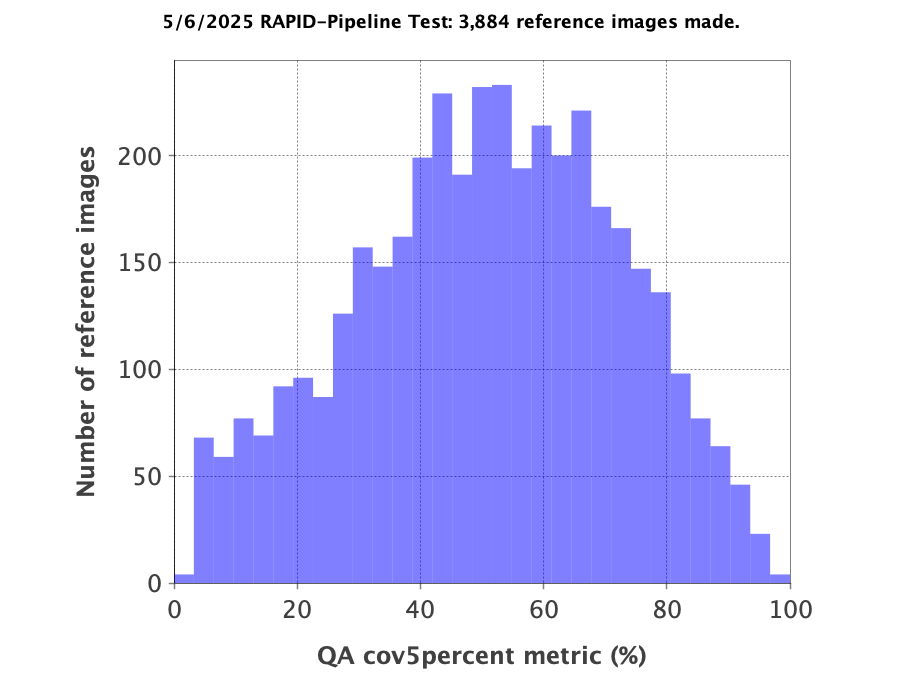
This test generated 3,884 new reference images, for 5 different filters and a variety of fields. The number of fields for each of the filter IDs included is listed as follows:
rapidopsdb=> select fid,count(*) from refimages where vbest>0 and created >= '20250506' group by fid order by fid;
 fid | count
-----+-------
   3 |   765
   4 |   780
   5 |   821
   6 |   821
   7 |   808
(5 rows)
These reference images, plus those generated by the standard test on 4/28/2025, give the following total numbers of reference images broken down by filter ID:
rapidopsdb=> select fid,count(*) from refimages where vbest>0 group by fid order by fid;
(7 rows)
 fid | count
-----+-------
   1 |   806
   2 |   812
   3 |   813
   4 |   810
   5 |   821
   6 |   821
   7 |   808
(7 rows)
Here is a histogram of the AWS Batch queue wait times for an available AWS Batch machine on which to run a pipeline job:

Here is a histogram of the job execution times, measured from pipeline start to pipeline finish on an AWS Batch machine:

Here is a 2-D histogram of the job execution times versus number of input frames in making reference images on the fly in this test:

Here is a histogram of nframes for all reference images made in this test:

Here is a histogram of cov5percent for all reference images made in this test:
5/8/2025
Test to process 3,020 exposure-SCAs, all in the observation date/time ranges given below, making reference images on the fly as needed. The observation date/time range is relatively early in the available range of the OpenUniverse simulated images. This test exercised the new Virtual Pipeline Operator (VPO) running in single-processing-date mode. AWS Batch machines for science-pipeline jobs have 2 vCPUs and 16 GB memory.
export STARTDATETIME="2028-09-12 00:00:00"
export ENDDATETIME="2028-09-15 00:00:00"

python3.11 /code/pipeline/virtualPipelineOperator.py 20250508 >& virtualPipelineOperator_20250508.out &
Here is a summary of the pipeline exit codes after the test:
rapidopsdb=> select ppid,exitcode,count(*) from jobs where cast(launched as date) = '20250508' group by ppid, exitcode order by ppid, exitcode;
 ppid | exitcode | count
------+----------+-------
   15 |        0 |  2924
   15 |       33 |    96
   17 |        0 |  2924
(3 rows)
Pipeline condition at termination |
Exitcode |
|---|---|
Normal |
0 |
SFFT failed due to singular matrix |
4 |
Reference image not available and could not be made |
33 |
Pipeline exit codes in the 0-31 range are considered normal, in the 32-63 range a warning, and 64 or greater an error. Even though SFFT might have failed, a difference image is still generated by ZOGY.
This test generated 1,500 new reference images, for 4 different filters and a variety of fields. The number of fields for each of the filter IDs included is listed as follows:
rapidopsdb=> select fid,count(*) from refimages where vbest>0 and created >= '20250508' group by fid order by fid;

 fid | count
-----+-------
   1 |   483
   2 |   495
   3 |    27
   4 |   495
(4 rows)
These reference images, plus those generated by previous tests, give the following total numbers of reference images broken down by filter ID:
rapidopsdb=> select fid,count(*) from refimages where vbest>0 group by fid order by fid;

fid | count
-----+-------
   1 |  1289
   2 |  1307
   3 |   840
   4 |  1305
   5 |   821
   6 |   821
   7 |   808
(7 rows)
5/10/2025
Test to process 13,850 exposure-SCA images, all in the observation date/time ranges given below, making reference images on the fly as needed. The observation date/time range is relatively early in the available range of the OpenUniverse simulated images. This test exercised, for the second time, the new Virtual Pipeline Operator (VPO) running in single-processing-date mode, only this test processed the largest number of images to date in a single run. Input images from filter IDs 1-7 in approximately equal numbers were processed by this test. AWS Batch machines for science-pipeline jobs have 2 vCPUs and 16 GB memory.
export STARTDATETIME="2028-09-15 00:00:00"
export ENDDATETIME="2028-09-25 00:00:00"

python3.11 /code/pipeline/virtualPipelineOperator.py 20250510 >& virtualPipelineOperator_20250510.out &
Here is a summary of the pipeline exit codes after the test (which are not unexpected):
rapidopsdb=> select ppid,exitcode,count(*) from jobs where cast(launched as date) = '20250510' group by ppid, exitcode order by ppid, exitcode;
 ppid | exitcode | count
------+----------+-------
   15 |        0 | 13506
   15 |        4 |    15
   15 |       33 |   329
   17 |        0 | 13521
(4 rows)
Pipeline condition at termination |
Exitcode |
|---|---|
Normal |
0 |
SFFT failed due to singular matrix |
4 |
Reference image not available and could not be made |
33 |
Pipeline exit codes in the 0-31 range are considered normal, in the 32-63 range a warning, and 64 or greater an error. Even though SFFT might have failed, a difference image is still generated by ZOGY.
This test generated 4,876 new reference images, for all the aforementioned seven filters and a variety of fields. The number of fields for each of the filter IDs included is listed as follows:
rapidopsdb=> select fid,count(*) from refimages where vbest>0 and created >= '20250510' group by fid order by fid;

 fid | count
-----+-------
   1 |   533
   2 |   523
   3 |   816
   4 |   523
   5 |   825
   6 |   825
   7 |   831
(7 rows)
These reference images, plus those generated by previous tests, give the following total numbers of reference images broken down by filter ID:
rapidopsdb=> select fid,count(*) from refimages where vbest>0 group by fid order by fid;

 fid | count
-----+-------
   1 |  1822
   2 |  1830
   3 |  1656
   4 |  1828
   5 |  1646
   6 |  1646
   7 |  1639
(7 rows)
Other key timing benchmarks for this test, which were done on an 8-core job-launcher machine (t3.2xlarge EC2 instance)
with 8-core multiprocessing:
Task |
Elapsed time in seconds |
|---|---|
Launch science pipelines |
7,747 |
Register Jobs, Diffimages, RefImages records for science pipelines |
2,545 |
Launch post-processing pipelines |
7,667 |
Register Jobs records for post-processing pipelines |
420 |
5/14/2025
Same as 4/28/2025 standard test, except that SFFT was run with the --crossconv flag. No new reference images
were made, as they already exist. The resulting SFFT difference image, sfftdiffimage_cconv_masked.fits, and the
SFFT decorrelated difference image, sfftdiffimage_dconv_masked.fits, are copied to the
S3 product bucket, along with the other products.
6/12/2025
Test to process 3,545 exposure-SCAs, all in the observation date/time ranges given below, making reference images on the fly as needed. The reference images are special in that their input frames are selected from the observation window 63,400 < MJD < 99,9999, which is later than the observation range of the test. The test covers only those field/filter combinations in which reference images can be made that have 6 input frames or more, which resulted in 79 reference images. The observation date/time range of the science images processed in this test is relatively early in the available range of the OpenUniverse simulated images, but spans more than a year. This test covers all seven filters included in the OpenUniverse dataset. A special pipeline-launch script is utilized.
For efficiency, the test is processed in two stages. In the first stage, only one representative science image per field/filter combination is processed to initially make the needed reference image for the other science images with the same field and filter. In the second stage, all other science images are processed (i.e., except the representative science images). The representative science image is the first in a time-ordered, SCA-ordered list for a given field and filter that is returned from a database query.
Only ZOGY difference-image products were made in this test.
export DBNAME=specialdb
export STARTDATETIME="2028-09-07 00:00:00"
export ENDDATETIME="2029-09-20 00:00:00"
export STARTREFIMMJDOBS=63400
export ENDREFIMMJDOBS=99999
export MINREFIMNFRAMES=6
export SPECIALRUNFLAG=True
export LAUNCHSCIENCEPIPELINESCODE=/code/pipeline/launchSciencePipelinesForDateTimeRangeWithRefImageWindow.py
export DRYRUN=False
export MAKEREFIMAGESFLAG=True
python3.11 /code/pipeline/virtualPipelineOperator.py 20250612 >& virtualPipelineOperator_20250612.out &
export MAKEREFIMAGESFLAG=False
python3.11 /code/pipeline/virtualPipelineOperator.py 20250612 >& virtualPipelineOperator_20250612_2.out &
db=> select ppid,exitcode,count(*) from jobs where cast(launched as date) = '20250612' group by ppid, exitcode order by ppid, exitcode;
 ppid | exitcode | count
------+----------+-------
   15 |        0 |  3545
   17 |        0 |  3545
(2 rows)
6/13/2025
Test to process 2,783 exposure-SCAs, all in the observation date/time ranges given below, which spans the observing year after that of the 20250612 test, utilizing the same reference images made for the 20250612 test.
Improvements and additional automation made to the VPO simplify the required run-time parameters, listed below.
export DBNAME=specialdb
export STARTDATETIME="2029-09-20 00:00:00"
export ENDDATETIME="2030-09-20 00:00:00"
export STARTREFIMMJDOBS=63400
export ENDREFIMMJDOBS=99999
export MINREFIMNFRAMES=6

python3.11 /code/pipeline/virtualPipelineOperator.py 20250613 >& virtualPipelineOperator_20250613.out &
6/17/2025
Test to process 547 exposure-SCAs, all in the observation date/time ranges given below (spanning 21 days), making reference images on the fly as needed (in order to test the VPO’s special logic for making reference images).
The observation date/time range of the science images processed in this test covers the earliest range of the OpenUniverse simulated images, all filters, not covered in the two previous tests.
For efficiency, the test is processed in two stages. In the first stage, only one representative science image per field/filter combination is processed to initially make the needed reference image for the other science images with the same field and filter. In the second stage, all other science images are processed (i.e., except the representative science images). The representative science image is the first in a time-ordered, SCA-ordered list for a given field and filter that is returned from a database query.
Only ZOGY difference-image products were made in this test.
export DBNAME=specialdb
export STARTDATETIME="2028-08-17 00:00:00"
export ENDDATETIME="2028-09-07 00:00:00"
export STARTREFIMMJDOBS=63400
export ENDREFIMMJDOBS=99999
export MINREFIMNFRAMES=6

python3.11 /code/pipeline/virtualPipelineOperator.py 20250617 >& virtualPipelineOperator_20250617.out &
specialdb=> select ppid,exitcode,count(*) from jobs where cast(launched as date) = '20250617' group by ppid, exitcode order by ppid, exitcode;
 ppid | exitcode | count
------+----------+-------
   15 |        0 |   547
   17 |        0 |   547
(2 rows)
6/20/2025
Same as the combined 6/12/2025, 6/13/2025, and 6/17/2025 tests, except that, in addition to the ZOGY
difference-image products, the SFFT difference-image products were also made.
Note that SFFT was run with the --crossconv flag.
No new reference images were made, as they already exist.
The resulting SFFT difference image, sfftdiffimage_cconv_masked.fits, and the
SFFT decorrelated difference image, sfftdiffimage_dconv_masked.fits, are copied to the
S3 product bucket, along with the other products.
Naive image-differencing was also done (simple science minus reference image), and the product is naive_diffimage_masked.fits.
export DBNAME=specialdb
export STARTDATETIME="2028-08-17 00:00:00"
export ENDDATETIME="2030-09-20 00:00:00"
export STARTREFIMMJDOBS=63400
export ENDREFIMMJDOBS=99999
export MINREFIMNFRAMES=6

python3.11 /code/pipeline/virtualPipelineOperator.py 20250620 >& virtualPipelineOperator_20250620.out &
specialdb=> select ppid,exitcode,count(*) from jobs where cast(launched as date) = '20250620' group by ppid, exitcode order by ppid, exitcode;
 ppid | exitcode | count
------+----------+-------
   15 |        0 |  6875
   17 |        0 |  6875
(2 rows)
7/10/2025
A repeat of the 6/20/2025 test, but with new PhotUtils PSF-fit star-finder catalog from ZOGY difference image (noniterative),
stored in a separate file called diffimage_masked_psfcat_finder.txt.
8/23/2025
Similar to the 7/10/2025 test, with the following exceptions:
Made correction to uncertainty-image formula.
New PSF-fit catalog for SFFT difference image.
Fake-source injection was turned on.
Changed [FAKE_SOURCES] num_injections = 100, mag_min = 21.0, mag_max = 28.0.
Changed [PSFCAT_DIFFIMAGE] fwhm = 2.0.
Changed [SEXTRACTOR_DIFFIMAGE] FILTER_THRESH = 3.0, DEBLEND_NTHRESH = 32, WEIGHT_TYPE = “NONE,MAP_RMS”, FILTER = “N” (last two parameters are overrided in code for ZOGY and SFFT SExtractor catalogs).
Fed ZOGY dxrmsfin = 0.0, dyrmsfin = 0.0 for comparison with SFFT.
Covers 6,875 science images. All science images in the 8/23 run had 100 fake sources injected per science image. This is in addition to the fake sources that are already included in the OpenUniverse simulation set.
New reference images were made with corrected uncertainties (79 total). The reference images are special in that their input frames are selected from the observation window 63,400 < MJD < 99,9999, which is later than the observation range of the test. The test covers only those field/filter combinations in which reference images can be made that have 6 input frames or more, which resulted in 79 reference images.
Note that SFFT was run with the --crossconv flag, as was done for the 6/20/25 and 7/10/25 tests,
but in those previous tests, the convolved and deconvolved SFFT difference images had their roles
mistakenly swapped (in terms of being fed to SExtractor downstream).
The resulting SFFT deconvolved difference image, sfftdiffimage_dconv_masked.fits, and the
SFFT convolved difference image, sfftdiffimage_cconv_masked.fits, are copied to the
S3 product bucket, along with the other products.
Naive image-differencing was also done (simple science minus reference image), and the product is naive_diffimage_masked.fits.
A new capability is computing an SExtractor catalog for the naive difference image, which is called naive_diffimage_masked.txt.
export DBNAME=fakesourcesdb
export STARTDATETIME="2028-08-17 00:00:00"
export ENDDATETIME="2030-09-20 00:00:00"
export STARTREFIMMJDOBS=63400
export ENDREFIMMJDOBS=99999
export MINREFIMNFRAMES=6

python3.11 /code/pipeline/virtualPipelineOperator.py 20250823 >& virtualPipelineOperator_20250823.out &
fakesourcesdb=> select ppid,exitcode,count(*) from jobs where cast(launched as date) = '20250823' group by ppid, exitcode order by ppid, exitcode;
 ppid | exitcode | count
------+----------+-------
   15 |        0 |  6875
   17 |        0 |  6875
(2 rows)
The VPO clocked 3.24 hours to run the entire test (all 6,875 science images). As shown in the table below for a particular pipeline instance, executing SFFT, executing AWAICGEN for reference-image generation, and injecting fake sources are the dominant factors affecting pipeline performance.
Pipeline step |
Execution time (sec) |
|---|---|
Downloading science image |
0.865 |
Downloading or generating reference image (9 input frames) |
129.247 |
Injecting fake sources |
51.104 |
Generating science-image catalog |
3.029 |
Swarping images |
8.826 |
Running bkgest on science image |
13.459 |
Running gainmatchscienceandreferenceimages |
5.845 |
Replacing nans, applying image offsets, etc. |
0.101 |
Running ZOGY |
39.043 |
Masking ZOGY difference image |
0.579 |
Running sextractor on ZOGY difference image |
3.901 |
Generating psf-fit catalog on ZOGY difference image |
15.247 |
Uploading main products to s3 bucket |
4.429 |
Running SFFT |
291.798 |
Uploading SFFT difference image to s3 bucket |
5.317 |
Running sextractor on SFFT difference image |
1.442 |
Uploading SFFT-diffimage sextractor catalog to s3 bucket |
0.109 |
Generating psf-fit catalog on SFFT difference image |
12.091 |
Uploading SFFT-diffimage psf-fit catalogs to s3 bucket |
0.800 |
Computing naive image difference |
1.211 |
Running sextractor on naive difference image |
4.671 |
Uploading products at pipeline end |
0.033 |
Total time to run one instance of science pipeline |
593.158 |
Typically only 1-4 science images in an exposure were processed in the 5,538 exposures covered by this test. Here is a breakdown of the number of science images processed per filter in this test:
fakesourcesdb=> select fid,count(*) from diffimages where vbest>0 and status>0 and created >= '2025-08-23' group by fid;
 fid | count
-----+-------
   7 |   770
   1 |   770
   5 |  1142
   4 |  1140
   2 |  1142
   6 |  1141
   3 |   770
(7 rows)
9/27/2025
Similar to the 8/23/2025 test, with the following bug fixes and additions:
Modified to not limit the precision of (ra, dec) in PSF-fit catalogs.
Added code to generate naive-difference-image PSF-fit catalogs.
Added code to generate SExtractor catalogs and PSF-fit catalogs for negative difference images (ZOGY, SFFT, naive).
Modified to feed sca_gain * exptime_sciimage as gain to method compute_diffimage_uncertainty.
Fixed bug: x and y subpixels offsets were swapped (adversely affected inputs to ZOGY, SFFT, and naive image-differencing).
Added new method normalize_image to normalize science-image PSFs (required by ZOGY).
The above additions cause more product files to be generated (namely, separate catalog files for negative difference images, with suffix “_negative” embedded in the filename).
Covers 6,875 science images. All science images in the 9/27 run had 100 fake sources injected per science image. This is in addition to the fake sources that are already included in the OpenUniverse simulation set.
New reference images were made with corrected uncertainties (79 total). The reference images are special in that their input frames are selected from the observation window 63,400 < MJD < 99,9999, which is later than the observation range of the test. The test covers only those field/filter combinations in which reference images can be made that have 6 input frames or more, which resulted in 79 reference images.
Note that SFFT was run with the --crossconv flag, as was done for the 8/23/25 test,
but in those previous tests, the convolved and deconvolved SFFT difference images had their roles
mistakenly swapped (in terms of being fed to SExtractor downstream).
The resulting SFFT deconvolved difference image, sfftdiffimage_dconv_masked.fits, and the
SFFT convolved difference image, sfftdiffimage_cconv_masked.fits, are copied to the
S3 product bucket, along with the other products.
Naive image-differencing was also done (simple science minus reference image), and the product is naive_diffimage_masked.fits.
A new capability is computing an SExtractor catalog for the naive difference image, which is called naive_diffimage_masked.txt.
export DBNAME=fakesourcesdb
export STARTDATETIME="2028-08-17 00:00:00"
export ENDDATETIME="2030-09-20 00:00:00"
export STARTREFIMMJDOBS=63400
export ENDREFIMMJDOBS=99999
export MINREFIMNFRAMES=6

python3.11 /code/pipeline/virtualPipelineOperator.py 20250927 >& virtualPipelineOperator_20250927.out &
fakesourcesdb=> select ppid,exitcode,count(*) from jobs where cast(launched as date) = '20250927' group by ppid, exitcode order by ppid, exitcode;
 ppid | exitcode | count
------+----------+-------
   15 |        0 |  6875
   17 |        0 |  6875
(2 rows)
The VPO clocked 3.55 hours to run the entire test (all 6,875 science images), with parallel processing (up to 10,000 machines with 1 machine per science image). As shown in the table below for a particular pipeline instance, executing SFFT, executing AWAICGEN for reference-image generation, and injecting fake sources are the dominant factors affecting pipeline performance.
Pipeline step |
Execution time (sec) |
|---|---|
Downloading science image |
0.910 |
Downloading or generating reference image |
128.579 |
Injecting fake sources |
57.766 |
Generating science-image catalog |
2.757 |
Swarping images |
9.153 |
Running bkgest on science image |
14.381 |
Running gainMatchScienceAndReferenceImages |
6.114 |
Replacing NaNs, applying image offsets, etc. |
0.105 |
Running ZOGY |
39.384 |
Masking ZOGY difference image |
0.951 |
Running SExtractor on positive ZOGY difference image |
3.823 |
Running SExtractor on negative ZOGY difference image |
1.599 |
Generating PSF-fit catalog on positive ZOGY difference image |
15.176 |
Generating PSF-fit catalog on negative ZOGY difference image |
9.631 |
Uploading main products to S3 bucket |
7.981 |
Running SFFT |
295.983 |
Uploading SFFT difference image to S3 bucket |
7.481 |
Running SExtractor on positive SFFT difference images |
1.424 |
Running SExtractor on negative SFFT difference images |
1.448 |
Uploading SFFT-diffimage SExtractor catalogs to S3 bucket |
0.196 |
Generating PSF-fit catalog on positive SFFT difference image |
12.655 |
Generating PSF-fit catalog on negative SFFT difference image |
11.014 |
Uploading SFFT-diffimage PSF-fit catalogs to S3 bucket |
1.626 |
Computing naive difference images |
2.212 |
Running SExtractor on positive naive difference image |
4.273 |
Running SExtractor on negative naive difference image |
1.662 |
Uploading SExtractor catalogs for naive difference images |
0.941 |
Running/uploading PSF-fit catalogs for naive difference images |
26.879 |
Uploading products at pipeline end |
0.037 |
Total time to run one instance of science pipeline |
666.143 |
Typically only 1-4 science images in an exposure were processed in the 5,538 exposures covered by this test. Here is a breakdown of the number of science images processed per filter in this test:
fakesourcesdb=> select fid,count(*) from diffimages where vbest>0 and status>0 and created >= '2025-09-27' group by fid;
 fid | count
-----+-------
   7 |   770
   1 |   770
   5 |  1142
   4 |  1140
   2 |  1142
   6 |  1141
   3 |   770
(7 rows)
The PSF-fit catalogs made by the Python photutils package from the ZOGY difference images, both positive and negative, were loaded into Sources child PostgreSQL database tables. The elapsed time to load all sources into the database was 14.7 minutes with 8 parallel processes. There were 13,767,979 Sources records loaded into the PostgreSQL database.
Cross-matching the sources, resulting in records loaded into the Merges_<field> and AstroObjects_<fields> database tables, for all fields of the sources, was done. The elapsed time to cross-match all sources was 3.5 hours with 8 parallel processes. This includes cross-matching across field boundaries for sources near field edges. A match radius of 0.1 arcsec (a Roman WFI pixel) was used. There were 3,269,268 AstroObjects records and 58,913,016 Merges records loaded into the PostgreSQL database. Of those merges (a.k.a. lightcurve data points), 15,449 merges resulted from cross-matching across field boundaries (i.e., the match radius can extend across a field boundary), which is an increase of 0.02623% in terms of number of merges.
The lightcurve statistics stored in the AstroObjects_<fields> database tables are updated after the cross-matching. This is done as a separate process. The AstroObjects_<fields> database tables are explicitly vacuumed and analyzed at the end of this process. For this test, all of this took 11 minutes.
2/27/2026
Similar to the 9/27/2025 test, but with the following bug fixes and additions:
Date |
Software modification |
|---|---|
10/10/2025 |
Added source matching within/without field boundaries to populate Sources, Merges, and AstroObjects database tables. |
10/11/2025 |
Added methods to compute statistics for AstroObjects database tables. |
10/29/2025 |
Set |
11/19/2025 |
Upgraded to SExtractor 2.28.2. |
11/25/2025 |
Modified |
12/4/2025 |
Explicitly cast data and uncertainty images as ndarrays when passed to PhotUtils methods (not sure whether this actually caused any problems). |
12/8/2025 |
Fixed call to |
12/17/2025 |
New SFFT python module that works on rimtimsim images. |
12/22/2025 |
Adjusted |
1/14/2026 |
Modified science pipeline to output catalogs in parquet format. |
1/24/2026 |
Added methods to delete not-best records in Sources and Merges database tables. |
1/30/2026 |
Developed code to generate sources and lightcurves HATS catalogs. |
1/31/2026 |
Various miscellaneous improvements such as modifications to run RAPID science pipeline on Mac laptop. |
2/3/2026 |
Created forced-photometry backend and added |
2/4/2026 |
Reduced-chi2 in PhotUtils catalogs and Sources database table. |
2/11/2026 |
Scaled reference-image inputs so that reference image has fixed zero point = 17 mag. |
2/12/2026 |
Modified to generate PhotUtils catalog for reference image. |
The above additions cause more product files to be generated (such as reference-image PhotUtils-catalog files in different formats).
Covers 6,875 science images. All science images in this run had 100 fake sources injected per science image. This is in addition to the fake sources that are already included in the OpenUniverse simulation set.
New reference images were made (79 total), and more useful keywords were included in the FITS header. The reference images are special in that their input frames are selected from the observation window 63,400 < MJD < 99,9999, which is later than the observation range of the science images that are processed in the test. The test covers only those field/filter combinations in which reference images can be made that have 6 input frames or more (which resulted in the aforementioned 79 reference images).
ZOGY image-difference products were generated, as well as SFFT and naive difference-image products.
Note that SFFT was run with the --crossconv flag, as was done for the 9/27/25 test.
The resulting SFFT deconvolved difference image, sfftdiffimage_dconv_masked.fits, and the
SFFT convolved difference image, sfftdiffimage_cconv_masked.fits, are copied to the
S3 product bucket, along with the other products.
Naive image-differencing is simply science minus reference image, and the product is naive_diffimage_masked.fits.
SExtractor and PhotUtils catalogs were generated for all three difference-image methods employed.
export DBNAME=fakesourcesdb
export STARTDATETIME="2028-08-17 00:00:00"
export ENDDATETIME="2030-09-20 00:00:00"
export STARTREFIMMJDOBS=63400
export ENDREFIMMJDOBS=99999
export MINREFIMNFRAMES=6

python3.11 /code/pipeline/virtualPipelineOperator.py 20260227 >& virtualPipelineOperator_20260227.out &
fakesourcesdb=> select ppid,exitcode,count(*) from jobs where cast(launched as date) = '20260227' group by ppid, exitcode order by ppid, exitcode;
 ppid | exitcode | count
------+----------+-------
   15 |        0 |  6875
   17 |        0 |  6875
(2 rows)
The VPO clocked 2.46 hours to run the product-file-generation pipeline test (not including loading Sources database tables and subsequent steps), in which difference-image products were generated for all 6,875 science images. Parallel processing, up to 10,000 machines with 1 machine per science image on AWS Batch facilitated the processing speed. As shown in the table below for a particular pipeline instance, executing SFFT, executing AWAICGEN for reference-image generation (depends on the number of input images), applying sub-pixel offsets to the reference image, injecting fake sources, and generating PhotUtils catalogs are the dominant factors affecting pipeline performance.
Pipeline step |
Execution time (sec) |
|---|---|
Downloading science image |
0.587 |
Uloading science image to product S3 bucket |
0.400 |
Downloading or generating reference image |
333.833 |
Uploading reference image to S3 product bucket |
5.383 |
Injecting fake sources |
54.371 |
Generating science-image catalog |
3.094 |
Swarping images |
8.807 |
Uploading intermediate FITS files to product S3 bucket |
3.519 |
Running bkgest on science image |
8.738 |
Running gainMatchScienceAndReferenceImages |
6.169 |
Replacing NaNs, applying image offsets, etc. |
91.259 |
Running ZOGY |
40.064 |
Masking ZOGY difference image |
0.894 |
Running SExtractor on positive ZOGY difference image |
4.232 |
Running SExtractor on negative ZOGY difference image |
1.663 |
Generating PSF-fit catalog on positive ZOGY difference image |
23.256 |
Generating PSF-fit catalog on negative ZOGY difference image |
12.590 |
Uploading main products to S3 bucket |
6.134 |
Running SFFT |
154.794 |
Uploading SFFT difference image to S3 product bucket |
6.349 |
Running SExtractor on positive SFFT difference images |
1.776 |
Running SExtractor on negative SFFT difference images |
1.729 |
Uploading SFFT-diffimage SExtractor catalogs to S3 product bucket |
0.157 |
Generating PSF-fit catalog on positive SFFT difference image |
15.669 |
Generating PSF-fit catalog on negative SFFT difference image |
14.473 |
Uploading SFFT-diffimage PSF-fit catalogs to S3 product bucket |
2.348 |
Computing naive difference images |
0.799 |
Uploading naive difference images to S3 product bucket |
1.326 |
Running SExtractor on positive naive difference image |
4.351 |
Running SExtractor on negative naive difference image |
1.700 |
Uploading SExtractor catalogs for naive difference images |
0.581 |
Generating PSF-fit catalog on positive naive difference image |
23.735 |
Generating PSF-fit catalog on negative naive difference image |
12.546 |
Uploading PSF-fit catalogs for naive difference images |
1.730 |
Uploading products at pipeline end to S3 product bucket |
0.036 |
Total time to run one instance of science pipeline |
849.093 |
Typically only 1-4 science images in an exposure were processed in the 5,538 exposures covered by this test. Here is a breakdown of the number of science images processed per filter in this test:
fakesourcesdb=> select fid,count(*) from diffimages where vbest>0 and status>0 and created >= '2026-02-27' group by fid;
 fid | count
-----+-------
   7 |   770
   1 |   770
   5 |  1142
   4 |  1140
   2 |  1142
   6 |  1141
   3 |   770
(7 rows)
The PSF-fit catalogs made by the Python photutils package from the ZOGY difference images, both positive and negative, were loaded into Sources child PostgreSQL database tables. The elapsed time to load all sources into the database was 17.0 minutes with 8 parallel processes. There were 13,722,343 Sources records loaded into the PostgreSQL database.
Cross-matching the sources with astronomical objects (called AstroObjects), resulting in records loaded into the Merges_<field> and AstroObjects_<fields> database tables, for all fields of the sources, was done. The elapsed time to cross-match all sources was 3.39 hours with 8 parallel processes. This includes cross-matching across field boundaries for sources near field edges. A match radius of 0.1 arcsec (a Roman WFI pixel) was used. There were 3,488,741 AstroObjects records and 66,449,889 Merges records loaded into the PostgreSQL database. Of those merges (a.k.a. lightcurve data points), 16,307 merges resulted from cross-matching across field boundaries (i.e., the match radius can extend across a field boundary), which is an increase of 0.02454% in terms of number of merges.
The lightcurve statistics stored in the AstroObjects_<fields> database tables are updated after the cross-matching. This is done as a separate process. Any AstroObjects_<fields> record with no associated sources in the Merges_<field> database table are deleted. A new Q3C index on the (meanra, meandec) columns is computed for all AstroObjects_<fields> database tables, and then these tables are set to logged, clustered, and analyzed. The AstroObjects_<fields> database tables are explicitly vacuumed at the end of this process. For this test, all of this took 15.44 minutes with 8 parallel processes.
It took 10.4 hours to delete non-best Merges_<fields> records with 8 parallel processes, which also included vacuuming and analyzing all Merges_<fields> database tables. The likely reason this process took so long to execute is that the cross-matching step was executed several times during testing/debugging on the same input data, which created many multiple redundant records.
It took 33 minutes to delete all not-best records in sources_20250927_* database tables with 8 parallel processes.
3/25/2026
Similar to the 2/27/2026 test, but with fake-source injection upgraded to inject variable sources with fixed sky positions. Thus, lightcurves can be generated from extractions of these fake sources over time. The fake-source injection of variables has also been extended to the input science images that are used to build the reference images.
New: Most of the ZOGY difference-image products now have the prefix “zogy_” in their filenames.
This test covers 6,875 science images. All science images in this run had 100 fake sources (variables) injected per science image. This is in addition to the fake sources that are already included in the OpenUniverse simulation set.
New reference images were made (79 total). The reference images are special in that their input frames are selected from the observation window 63,400 < MJD < 99,9999, which is later than the observation range of the science images that are processed in the test. The test covers only those field/filter combinations in which reference images can be made that have 6 input frames or more (which resulted in the aforementioned 79 reference images). The reference images are associated with 21 distinct fields, and for each of these fields there are reference images for three or more WFI bandpasses, as shown in the following query results:
fakesourcesdb=> select field, count(*) from refimages where vbest>0 group by field order by field;
  field  | count
---------+-------
 5257274 |     3
 5261331 |     4
 5261333 |     4
 5285570 |     3
 5293565 |     3
 5297552 |     4
 5297554 |     4
 5297558 |     4
 5321341 |     4
 5325281 |     4
 5325283 |     4
 5333116 |     4
 5352605 |     4
 5356461 |     3
 5356467 |     3
 5356469 |     3
 5356473 |     7
 5356477 |     3
 5356479 |     4
 5364185 |     3
 5364186 |     4
(21 rows)
Here is the breakdown of number of reference images per number of input frames and quality-assurance metric cov5percent:


The quality-assurance metric cov5percent, given by the keyword COV5PERC in the FITS header of each RAPID reference image, is an absolute quantifier for the aggregate areal-depth coverage of a reference image at a reference depth of 5, corresponding to a coadd depth of at least 5 input images. It is computed from the reference-image coverage map. It is defined as a percentage of the sum of the limited coverage of all pixels in an image, where the limited coverage is all coverage and any coverage greater than 5 that is reset to 5 for scoring purposes, relative to 5 times the total number of pixels in the image.
ZOGY image-difference products were generated, as well as SFFT and naive difference-image products.
Note that SFFT was run with the --crossconv flag, as was done for the 2/27/26 test.
The resulting SFFT deconvolved difference image, sfftdiffimage_dconv_masked.fits, and the
SFFT convolved difference image, sfftdiffimage_cconv_masked.fits, are copied to the
S3 product bucket, along with the other products.
Naive image-differencing is simply science minus reference image, and the product is naive_diffimage_masked.fits.
SExtractor and PhotUtils catalogs were generated for all three difference-image methods employed.
export DBNAME=fakesourcesdb
export STARTDATETIME="2028-08-17 00:00:00"
export ENDDATETIME="2030-09-20 00:00:00"
export STARTREFIMMJDOBS=63400
export ENDREFIMMJDOBS=99999
export MINREFIMNFRAMES=6

python3.11 /code/pipeline/virtualPipelineOperator.py 20260325 >& virtualPipelineOperator_20260325.out &
fakesourcesdb=> select ppid,exitcode,count(*) from jobs where cast(launched as date) = '20260325' group by ppid, exitcode order by ppid, exitcode;
 ppid | exitcode | count
------+----------+-------
   15 |        0 |  6875
   17 |        0 |  6875
(2 rows)
The following 2-D histogram shows job elapsed time versus job start time for parallel-processing of RAPID science pipelines under AWS Batch with up to 10,000 machines permitted in the job queue. The group of bins in the upper left corresponds to the 79 pipeline instances that generated all of the reference images needed for the test. Since fake-variable-source injection is now done in the reference-image inputs, the run times are significantly higher relative to previous tests. The group of bins in the middle corresponds to pipeline instances for the rest of the science images that will have precomputed reference images (from the first group of 79 pipeline instances ran earlier). The group of bins in the lower right corresponds to instances of the post-processing pipeline, the purpose of which is to finalize the pipeline products, performing tasks such as updating FITS headers, and computing file checksums. Post-processing pipelines also run in parallel under AWS Batch.

The VPO clocked 2.8 hours to run the product-file-generation pipeline test (not including loading Sources database tables and subsequent steps), in which difference-image products were generated for all 6,875 science images. Parallel processing, up to 10,000 machines with 1 machine per science image on AWS Batch facilitated the processing speed. The average AWS-Batch queue wait time was 141 s (stddev=13.7 s); queue wait times vary from day to day, and can range from minutes to hours depending on machine availability.
As shown in the table below for the longest running pipeline instance (jid = 90894), executing AWAICGEN for reference-image generation (depends on the number of input images; NFRAMES=14 for this case), executing SFFT, injecting fake sources (both science image and reference-image inputs), and generating PhotUtils catalogs are the dominant factors affecting pipeline performance.
Pipeline step |
Execution time (sec) |
|---|---|
Downloading science image |
0.590 |
Uploading science image to product S3 bucket |
0.372 |
Downloading or generating reference image |
1687.838 |
Uploading reference image to S3 product bucket |
2.898 |
Injecting fake sources |
108.987 |
Generating science-image catalog |
3.412 |
Swarping images |
8.767 |
Uploading intermediate FITS files to product S3 bucket |
3.249 |
Running bkgest on science image |
8.381 |
Running gainMatchScienceAndReferenceImages |
6.792 |
Replacing NaNs, applying image offsets, etc. |
0.096 |
Running ZOGY |
39.313 |
masking ZOGY difference image |
0.877 |
Running SExtractor on positive ZOGY difference image |
4.813 |
Running SExtractor on negative ZOGY difference image |
2.538 |
Generating PSF-fit catalog on positive ZOGY difference image |
36.232 |
Generating PSF-fit catalog on negative ZOGY difference image |
19.169 |
Uploading main products to S3 bucket |
5.300 |
Running SFFT |
142.225 |
Uploading SFFT difference image to S3 product bucket |
6.107 |
Running SExtractor on positive SFFT difference images |
2.906 |
Running SExtractor on negative SFFT difference images |
2.332 |
Uploading SFFT-diffimage SExtractor catalogs to S3 product bucket |
0.177 |
Generating PSF-fit catalog on positive SFFT difference image |
27.088 |
Generating PSF-fit catalog on negative SFFT difference image |
21.861 |
Uploading SFFT-diffimage PSF-fit catalogs to S3 product bucket |
1.236 |
Computing naive difference images |
0.710 |
Uploading naive difference images to S3 product bucket |
0.881 |
Running SExtractor on positive naive difference image |
4.245 |
Running SExtractor on negative naive difference image |
1.702 |
Uploading SExtractor catalogs for naive difference images |
0.844 |
Generating PSF-fit catalog on positive naive difference image |
36.271 |
Generating PSF-fit catalog on negative naive difference image |
19.198 |
Uploading PSF-fit catalogs for naive difference images to |
1.192 |
Uploading products at pipeline end to S3 product bucket |
0.036 |
Total time to run one instance of science pipeline |
2208.632 |
Typically only 1-4 science images in an exposure were processed in the 5,538 exposures covered by this test. Here is a breakdown of the number of science images processed per filter in this test:
fakesourcesdb=> select fid,count(*) from diffimages where vbest>0 and status>0 and created >= '2026-03-25' group by fid;
 fid | count
-----+-------
   7 |   770
   1 |   770
   5 |  1142
   4 |  1140
   2 |  1142
   6 |  1141
   3 |   770
(7 rows)
The PSF-fit catalogs made by the Python photutils package from the ZOGY difference images, both positive and negative, were loaded into Sources child PostgreSQL database tables. The elapsed time to load all sources into the database was 16.9 minutes with 8 parallel processes. There were 14,327,713 Sources records loaded into the PostgreSQL database.
Cross-matching the sources with astronomical objects (called AstroObjects), resulting in records loaded into the Merges_<field> and AstroObjects_<fields> database tables, for all 262 fields of the sources, was done. The elapsed time to cross-match all sources was 3.392 hours with 8 parallel processes. This includes cross-matching across field boundaries for sources near field edges. A match radius of 0.1 arcsec (a Roman WFI pixel) was used. There were 3,623,747 AstroObjects records and 69,111,195 Merges records loaded into the PostgreSQL database. Of those merges (a.k.a. lightcurve data points), 17,760 merges resulted from cross-matching across field boundaries (i.e., the match radius can extend across a field boundary), which is an increase of 0.02570% in terms of number of merges.
The lightcurve statistics stored in the AstroObjects_<fields> database tables are updated after the cross-matching. This is done as a separate process. Any AstroObjects_<fields> record with no associated sources in the Merges_<field> database table are deleted. A new Q3C index on the (meanra, meandec) columns is computed for all AstroObjects_<fields> database tables, and then these tables are set to logged, clustered, and analyzed. The AstroObjects_<fields> database tables are explicitly vacuumed at the end of this process. For this test, all of this took 30.34 minutes with 8 parallel processes.
It took 2.40 hours to delete non-best Merges_<fields> records with 8 parallel processes, which also included vacuuming and analyzing all Merges_<fields> database tables. The likely reason this process took so long to execute is that the cross-matching step was executed several times during testing/debugging on the same input data, which created many multiple redundant records.
It took 28.50 minutes to delete all not-best records in sources_20260227_* database tables with 8 parallel processes.
5/13/2026
Similar to the 3/25/2026 test, but with substantial pipeline improvements as listed in the table below.
In this test, the PSF-fit catalogs loaded into the database are from SFFT difference images,
instead of ZOGY difference images as in the 3/25/2026 test. Other noteworthy pipeline improvements are
all the upgrades to crossMatchSources.py and the reduction of the match radius to 0.00001528 degrees (half a Roman WFI pixel).
Date |
Software modification |
|---|---|
4/7/2026 |
Modified SFFT code to output a difference-image PSF |
4/9/2026 |
Changes to how the uncertainty images are calculated (for science image and refimage inputs). |
4/13/2026 |
Replaces hard-wired value 1750.0 with |
4/16/2026 |
Modified crossMatchSources.py to only cross-match sources with |
4/17/2026 |
Modified crossMatchSources.py to cross-match using AstroObjects |
4/17/2026 |
Modified crossMatchSources.py to update AstroObjects |
4/20/2026 |
Modified to cross-match all sources in one observation at a time for all SCAs in ascending time order. |
4/20/2026 |
Modified to load into RAPID operations database the SFFT-difference-image PhotUtils catalogs, instead of ZOGY. |
4/21/2026 |
Modified to replace NaNs, if any, in SFFT difference image with zeros. |
4/21/2026 |
Modified to replace NaNs, if any, in difference-image uncertainty images with |
4/21/2026 |
Increased |
4/22/2026 |
Modified SFFT command for rimtimsims to use the brute-force masking options ( |
4/22/2026 |
In the latest version of PhotUtils, output column name |
4/23/2026 |
Modified to use |
4/24/2026 |
Changed |
4/28/2026 |
Modified SFFT code to refactor bright star masking in |
4/28/2026 |
Modified SFFT code to replace the slow per-pixel distance loop with |
4/28/2026 |
Modified SFFT code so that when a SExtractor catalog is provided, a second pass after catalog masking to catch any remaining bright pixels above |
4/29/2026 |
Modified SFFT code to fix logic path issues, and set |
5/12/2026 |
Modified to scale the reference-image uncertainty map by the gain-matching scale factor (prior to this, gain-matching was only applied to the reference image). |
5/12/2026 |
Moved the block of code that uploads intermediate products to just before ZOGY execution (this facilitates running ZOGY offline from S3-bucket downloaded inputs). |
Like the 3/25/2026 test, the injected variable fake sources have fixed sky positions, and the fake-source injection of variables has been extended to the input science images that are used to build the reference images. Thus, lightcurves can be generated from extractions of these fake sources over time.
This test covers 6,875 science images. All science images in this run had 100 fake sources (variables) injected per science image. This is in addition to the fake sources that are already included in the OpenUniverse simulation set.
New reference images were made (79 total). More details about the reference images are given in the 3/25/2026 description above.
ZOGY image-difference products were generated, as well as SFFT and naive difference-image products.
Note that SFFT was run with the --crossconv flag, as was done for the 3/25/2026 test.
The resulting SFFT deconvolved difference image, sfftdiffimage_dconv_masked.fits, and the
SFFT convolved difference image, sfftdiffimage_cconv_masked.fits, are copied to the
S3 product bucket, along with the other products.
Naive image-differencing is simply science minus reference image, and the product is naive_diffimage_masked.fits.
SExtractor and PhotUtils catalogs were generated for all three difference-image methods employed.
export DBNAME=fakesourcesdb
export STARTDATETIME="2028-08-17 00:00:00"
export ENDDATETIME="2030-09-20 00:00:00"
export STARTREFIMMJDOBS=63400
export ENDREFIMMJDOBS=99999
export MINREFIMNFRAMES=6

python3.11 /code/pipeline/virtualPipelineOperator.py 20260513 >& virtualPipelineOperator_20260513.out &
fakesourcesdb=> select ppid,exitcode,count(*) from jobs where cast(launched as date) = '20260513' group by ppid, exitcode order by ppid, exitcode;
 ppid | exitcode | count
------+----------+-------
   15 |        0 |  6875
   17 |        0 |  6875
(2 rows)
The VPO clocked 2.48 hours to run the product-file-generation pipeline test (not including loading Sources database tables and subsequent steps), in which difference-image products were generated for all 6,875 science images. Parallel processing, up to 10,000 machines with 1 machine per science image on AWS Batch facilitated the processing speed. A detailed breakdown of the pipeline steps can be found above in the description of the 3/25/2026 test.
Typically only 1-4 science images in an exposure were processed in the 5,538 exposures covered by this test. Here is a breakdown of the number of science images processed per filter in this test:
fakesourcesdb=> select fid,count(*) from diffimages where vbest>0 and status>0 and created >= '2026-03-25' group by fid;
 fid | count
-----+-------
   7 |   770
   1 |   770
   5 |  1142
   4 |  1140
   2 |  1142
   6 |  1141
   3 |   770
(7 rows)
The PSF-fit catalogs made by the Python photutils package from the SFFT difference images, both positive and negative, were loaded into Sources child PostgreSQL database tables (unlike the 3/25/2026 test, in which the PSF-fit catalogs from the ZOGY difference images were loaded). The elapsed time to load all sources into the database was 17.9 minutes with 8 parallel processes. There were 14,239,446 Sources records loaded into the PostgreSQL database.
Cross-matching the sources with astronomical objects (called AstroObjects), resulting in records loaded into the Merges_<field> and AstroObjects_<fields> database tables, for all 196 fields of the sources, was done. The elapsed time to cross-match all sources was 4.084 hours with 8 parallel processes. This includes cross-matching across field boundaries for sources near field edges. A match radius of 0.055 arcseconds was used (half a Roman WFI pixel). There were 6,277,546 AstroObjects records and 39,396,561 Merges records loaded into the PostgreSQL database. Of those merges (a.k.a. lightcurve data points), 9,945 merges resulted from cross-matching across field boundaries (i.e., the match radius can extend across a field boundary), which is an increase of 0.02524% in terms of number of merges.
The lightcurve statistics stored in the AstroObjects_<fields> database tables are updated after the cross-matching. This is done as a separate process. Any AstroObjects_<fields> record with no associated sources in the Merges_<field> database table are deleted. A new Q3C index on the (meanra, meandec) columns is computed for all AstroObjects_<fields> database tables, and then these tables are set to logged, clustered, and analyzed. The AstroObjects_<fields> database tables are explicitly vacuumed at the end of this process. For this test, all of this took 20.99 minutes with 8 parallel processes.
It took 1.26 hours to delete non-best Merges_<fields> records with 8 parallel processes, which also included vacuuming and analyzing all Merges_<fields> database tables.
It took 32.87 minutes to delete all not-best records in sources_20260325_* database tables with 8 parallel processes.
5/20/2026
Similar to the 5/13/2026 test, except the following pipeline improvement has been included, which will improve the ZOGY difference images and its downstream products:
Date |
Software modification |
|---|---|
5/19/2026 |
Modified to feed ZOGY scaled std_ref_img by scalefacref (gain-matching correction). |
Like the 5/13/2026 test, the injected variable fake sources have fixed sky positions, and the fake-source injection of variables has been extended to the input science images that are used to build the reference images. Thus, lightcurves can be generated from extractions of these fake sources over time.
This test covers 6,875 science images. All science images in this run had 100 fake sources (variables) injected per science image. This is in addition to the fake sources that are already included in the OpenUniverse simulation set.
New reference images were made (79 total). More details about the reference images are given in the 3/25/2026 description above.
ZOGY image-difference products were generated, as well as SFFT and naive difference-image products.
Note that SFFT was run with the --crossconv flag, as was done for the 5/13/2026 test.
The resulting SFFT deconvolved difference image, sfftdiffimage_dconv_masked.fits, and the
SFFT convolved difference image, sfftdiffimage_cconv_masked.fits, are copied to the
S3 product bucket, along with the other products.
Naive image-differencing is simply science minus reference image, and the product is naive_diffimage_masked.fits.
SExtractor and PhotUtils catalogs were generated for all three difference-image methods employed.
export DBNAME=fakesourcesdb
export STARTDATETIME="2028-08-17 00:00:00"
export ENDDATETIME="2030-09-20 00:00:00"
export STARTREFIMMJDOBS=63400
export ENDREFIMMJDOBS=99999
export MINREFIMNFRAMES=6

python3.11 /code/pipeline/virtualPipelineOperator.py 20260513 >& virtualPipelineOperator_20260513.out &
fakesourcesdb=> select ppid,exitcode,count(*) from jobs where cast(launched as date) = '20260520' group by ppid, exitcode order by ppid, exitcode;
 ppid | exitcode | count
------+----------+-------
   15 |        0 |  6875
   17 |        0 |  6875
(2 rows)
The VPO clocked 2.47 hours to run the product-file-generation pipeline test (not including loading Sources database tables and subsequent steps), in which difference-image products were generated for all 6,875 science images. Parallel processing, up to 10,000 machines with 1 machine per science image on AWS Batch facilitated the processing speed. A detailed breakdown of the pipeline steps can be found above in the description of the 3/25/2026 test.
Typically only 1-4 science images in an exposure were processed in the 5,538 exposures covered by this test. Here is a breakdown of the number of science images processed per filter in this test:
fakesourcesdb=> select fid,count(*) from diffimages where vbest>0 and status>0 and created >= '2026-03-25' group by fid;
 fid | count
-----+-------
   7 |   770
   1 |   770
   5 |  1142
   4 |  1140
   2 |  1142
   6 |  1141
   3 |   770
(7 rows)
The PSF-fit catalogs made by the Python photutils package from the SFFT difference images, both positive and negative, were loaded into Sources child PostgreSQL database tables. The elapsed time to load all sources into the database was 17.6 minutes with 8 parallel processes. There were 14,239,540 Sources records loaded into the PostgreSQL database.
Cross-matching the sources with astronomical objects (called AstroObjects), resulting in records loaded into the Merges_<field> and AstroObjects_<fields> database tables, for all 196 fields of the sources, was done. The elapsed time to cross-match all sources was 1.47 hours with 8 parallel processes. This includes cross-matching across field boundaries for sources near field edges. A match radius of 0.055 arcseconds was used (half a Roman WFI pixel). There were 5,216,999 AstroObjects records and 15,970,855 Merges records loaded into the PostgreSQL database. Of those merges (a.k.a. lightcurve data points), 3,350 merges resulted from cross-matching across field boundaries (i.e., the match radius can extend across a field boundary), which is an increase of 0.02098% in terms of number of merges.
Prior to this test, all AstroObjects_<field> and Merges_<field> table were dropped. Differences in numbers of AstroObjects and Merges records between this test and the 5/13/2026 test are attributed to insufficient database clean-up (i.e., redundancies owing to multiple tests, not necessarily documented). Additional development effort to address this issue is needed here.
The lightcurve statistics stored in the AstroObjects_<fields> database tables are updated after the cross-matching. This is done as a separate process. Any AstroObjects_<fields> record with no associated sources in the Merges_<field> database table are deleted. A new Q3C index on the (meanra, meandec) columns is computed for all AstroObjects_<fields> database tables, and then these tables are set to logged, clustered, and analyzed. The AstroObjects_<fields> database tables are explicitly vacuumed at the end of this process. For this test, all of this took 15.46 minutes with 8 parallel processes.